
Zero Waste Operations
Venison & Utilisation — Nothing Goes to Waste
Every deer harvested by PJD is treated with respect. Venison is processed for consumption, hides and antlers are retained where practical, and carcasses are handled responsibly. Pest control doesn't have to mean waste.
From Pest to Plate — The Full Picture
One of the most common questions Paul gets from landholders is: 'What happens to the deer?' It's a fair question, and the answer matters — both ethically and practically. The short answer is that nothing goes to waste if Paul can help it.
Sambar, Red and Fallow deer are all excellent table fare. Wild venison is lean, flavoursome and free of the hormones and additives found in farmed meat. Where operations allow for safe, hygienic field processing, harvested deer are broken down in the field and the venison is utilised — either by Paul, the landholder, or distributed to others.
This approach also has a practical benefit for landholders: it means carcasses aren't left in paddocks to attract scavengers, foul water sources or create biosecurity risks. A clean, professional operation from start to finish.
How Harvested Animals Are Utilised
Venison for Consumption
Where field conditions allow safe, hygienic processing, harvested deer are broken down and the venison utilised. Wild Sambar and Fallow venison are highly regarded — lean, rich in flavour and completely free-range.
Hides & Skins
Deer hides are retained where practical. Quality Sambar hides in particular have value for leather working and traditional uses. Paul retains or distributes hides rather than leaving them in the field.
Antlers & Trophy Material
Antlers from mature stags are retained. Sambar antlers are sought after for knife handles, decorative use and traditional medicine. Nothing of value is discarded unnecessarily.
Responsible Carcass Disposal
Where full utilisation isn't practical — remote terrain, large numbers, or biosecurity requirements — carcasses are disposed of responsibly and away from water sources, livestock and property infrastructure.
Landholder First
The landholder always has first right to any venison, hides or antlers from operations on their property. Paul will discuss this before any operation begins so expectations are clear.
No Waste Policy
Paul's operating philosophy is simple: if an animal is taken, it should be used. This reflects both respect for the animal and a commitment to professional, ethical pest management.
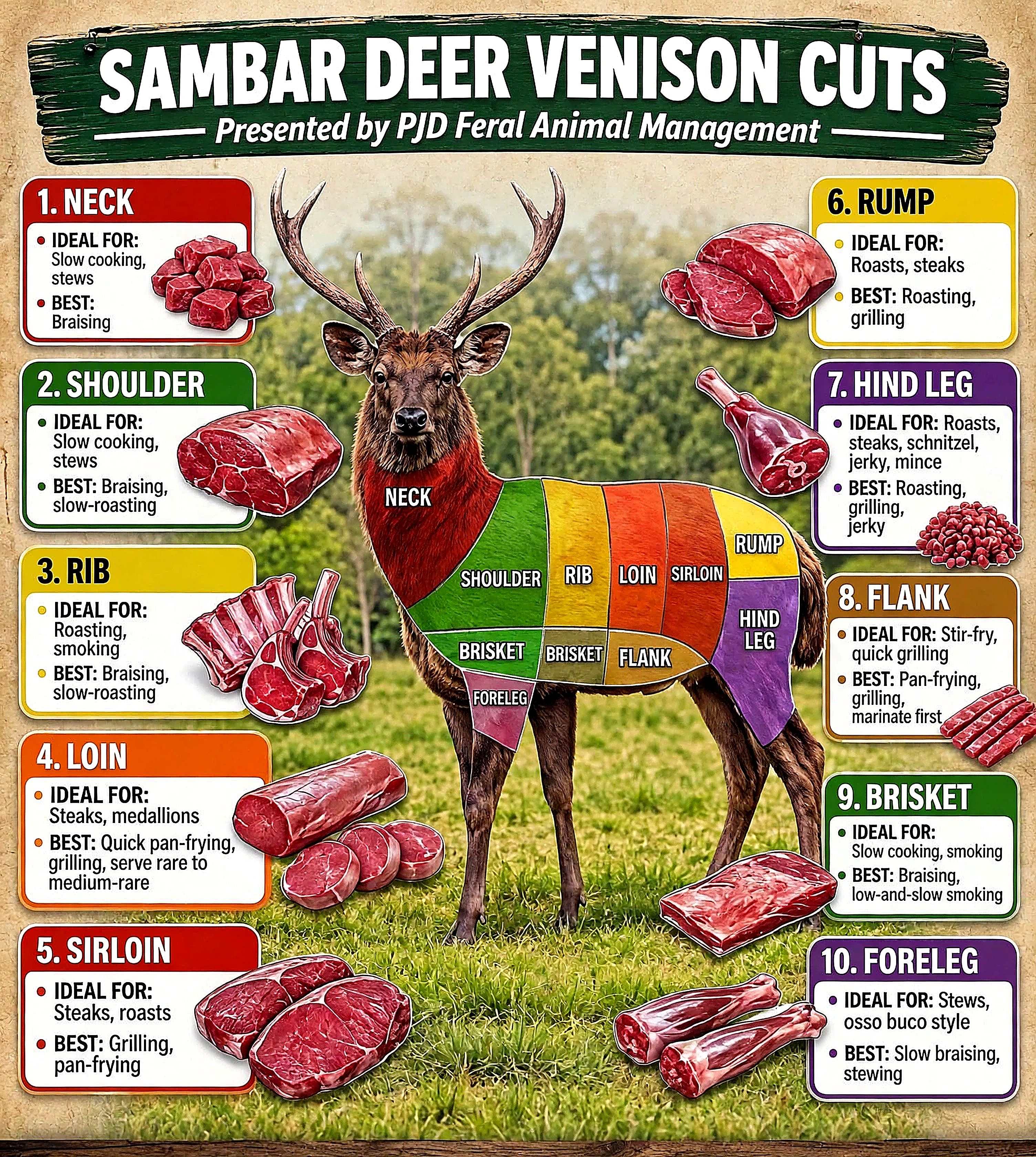
Sambar Deer — Primal Cuts Guide
Understanding the cuts from a harvested Sambar deer helps landholders and hunters get the most from every animal. Sambar are large-bodied deer — a mature stag can yield 60–90 kg of usable meat.
| Cut | Cooking |
|---|---|
| Backstrap The prime cut. Runs along either side of the spine. Tender, lean and best cooked quickly — pan-seared medium-rare or on the grill. The most prized cut on any deer. | Pan-sear, grill, BBQ |
| Hindquarter The largest muscle group. Includes the rump, topside, silverside and eye of round. Versatile — roast whole, slice into steaks, or dice for slow-cook dishes. | Roast, steaks, slow cook, stew |
| Tenderloin Small but exceptionally tender. Located inside the carcass along the spine. Often eaten in the field on the day of harvest. Cook quickly over high heat. | Pan-sear, whole roast |
| Shoulder Well-worked muscle — best suited to low-and-slow cooking. Ideal for pulled venison, braises, curries and slow-roasted shoulder. Excellent flavour. | Slow roast, braise, pulled venison, curry |
| Neck Heavily worked and full of connective tissue. Requires long, slow cooking to break down. Makes outstanding braises, osso buco-style dishes and rich stocks. | Braise, osso buco, stock |
| Ribs & Flank Thin and flavoursome. Ribs can be slow-cooked or smoked. Flank is best marinated and cooked quickly, or minced. Often used for venison sausages and mince. | Slow cook, smoke, mince, sausages |
| Shank The lower leg. Tough but deeply flavoured. Classic osso buco cut — braise low and slow until the meat falls from the bone. Excellent for stocks and soups. | Braise, osso buco, stock, soup |
| Mince & Trim All trim from the carcass is minced. Venison mince is lean and versatile — use in bolognese, burgers, meatballs, pies and sausages. Mix with pork fat for juicier results. | Bolognese, burgers, pies, sausages |
Note: Yield and cut quality vary with animal age, sex, season and field conditions. Hanging carcasses for 3–5 days in cool conditions (2–4°C) significantly improves tenderness across all cuts.
Species-by-Species Cuts & Cooking Guide
Each species managed by PJD produces distinctly different meat. Use these guides to get the best result from every animal — whether it's a Sambar stag, Fallow buck, Red deer, feral goat or rabbit.
Cervus unicolor
Sambar Deer
Dressed weight: 60–90 kg dressed
Flavour Profile
Rich, dark, deeply flavoured — the most intensely flavoured Victorian deer. Mature stags are stronger; hinds and younger animals milder.
Hanging Advice
Hang 3–5 days at 2–4°C. Essential for Sambar — significantly improves tenderness and mellows the flavour.
Top Tip
Always remove the tarsal glands (hock glands) immediately after harvest — they taint the meat if left on.
| Cut | Notes |
|---|---|
| BackstrapPrime | Pan-sear medium-rare, grill, BBQ The showpiece cut. Slice into medallions, sear 2 min each side, rest 5 min. Season simply — salt, pepper, rosemary. |
| TenderloinPrime | Pan-sear whole, quick roast Often eaten in the field. Cook whole over high heat, 3–4 min total. Do not overcook. |
| HindquarterRoasting | Roast, steaks, slow cook, stew Break into topside, silverside, rump and eye of round. Roast at 180°C to medium-rare, or slice into steaks. |
| ShoulderSlow-cook | Slow roast 6–8 hrs, braise, pulled venison Best cooked low and slow. Pulled Sambar shoulder with bush spices is outstanding. Add fat (olive oil, butter) to compensate for leanness. |
| NeckSlow-cook | Braise, osso buco, rich stock Slice into rounds for osso buco. Braise 3–4 hrs with red wine, tomato and aromatics. Deeply flavoured. |
| Ribs & FlankMince / trim | Slow cook, smoke, mince, sausages Ribs benefit from a long smoke or braise. Flank: marinate 24 hrs, grill fast, slice thin against the grain. |
| ShankBraise | Braise 3–4 hrs, osso buco, stock Classic osso buco. Braise with gremolata, served on soft polenta. Also excellent for bone broth. |
| Mince & TrimMince / trim | Bolognese, burgers, pies, sausages Blend with 20% pork fat for burgers and sausages. Sambar mince bolognese is rich and deeply flavoured — cook low and slow. |
Dama dama
Fallow Deer
Dressed weight: 25–40 kg dressed
Flavour Profile
Mild, delicate, slightly sweet — the most approachable venison. Often compared to lamb or veal. Ideal for those new to game meat.
Hanging Advice
Hang 2–3 days at 2–4°C. Fallow doesn't need as long as Sambar — already tender and mild.
Top Tip
Fallow venison can dry out quickly due to low fat. Baste frequently when roasting, or wrap in caul fat or bacon.
| Cut | Notes |
|---|---|
| BackstrapPrime | Pan-sear, grill, carpaccio Exceptionally tender. Slice thin for carpaccio with capers and parmesan, or sear 90 sec each side for a delicate medium-rare. |
| TenderloinPrime | Pan-sear whole, tartare Mild enough for venison tartare. Or sear whole in butter with thyme — 3 min total. |
| HindquarterRoasting | Roast, schnitzels, steaks Topside makes excellent schnitzels — pound thin, crumb and pan-fry. Rump roasts beautifully at 170°C. |
| ShoulderSlow-cook | Slow roast 4–5 hrs, braise, ragù Milder than Sambar shoulder — suits Italian-style ragù with white wine and herbs. Pull apart and toss through pasta. |
| NeckSlow-cook | Braise, slow cook, stock Braise with white wine, leek and cream for a refined result. Fallow neck is less gamey than Sambar. |
| Ribs & FlankMince / trim | Mince, sausages, slow cook Fallow ribs are small — best minced or slow-cooked. Flank: marinate in citrus and herbs, grill fast. |
| ShankBraise | Braise 2–3 hrs, osso buco Smaller than Sambar shanks. Braise with white wine and gremolata for a lighter osso buco. |
| Mince & TrimMince / trim | Burgers, meatballs, pies, sausages Fallow mince is mild and versatile. Excellent in meatballs with Italian herbs. Add pork fat for moisture. |
Cervus elaphus
Red Deer
Dressed weight: 40–70 kg dressed
Flavour Profile
Medium, well-rounded, slightly gamey — sits between Sambar and Fallow. Well-regarded by game meat enthusiasts. Versatile across cooking methods.
Hanging Advice
Hang 3–4 days at 2–4°C. Similar to Sambar but slightly less time needed.
Top Tip
Red deer fat can be waxy and strong-flavoured — trim all visible fat before cooking for the best result.
| Cut | Notes |
|---|---|
| BackstrapPrime | Pan-sear, grill, roast Excellent quality. Slightly more marbling than Sambar. Sear in cast iron with butter and garlic — medium-rare is ideal. |
| TenderloinPrime | Pan-sear, quick roast Tender and well-flavoured. Cook whole over high heat, baste with butter. Rest 5 min before slicing. |
| HindquarterRoasting | Roast, steaks, slow cook Topside and silverside roast beautifully. Rump steaks are excellent on the BBQ. Dice for hearty stews. |
| ShoulderSlow-cook | Slow roast 5–7 hrs, braise, curry Rich and flavoursome when slow-cooked. Red deer shoulder curry with native spices is outstanding. |
| NeckSlow-cook | Braise, osso buco, stock Braise with red wine and root vegetables. Red deer neck produces a deeply flavoured, gelatinous braise. |
| Ribs & FlankMince / trim | Slow cook, smoke, mince Ribs suit a long smoke or braise. Flank: marinate in red wine and garlic, grill hot and fast. |
| ShankBraise | Braise 3–4 hrs, osso buco, stock Excellent osso buco. Braise with red wine, tomato and olives. Serve with creamy mash or soft polenta. |
| Mince & TrimMince / trim | Bolognese, burgers, pies, sausages Well-balanced flavour for mince. Excellent in cottage pie or venison bolognese. Blend with pork fat for sausages. |
Capra hircus
Feral Goat
Dressed weight: 12–25 kg dressed
Flavour Profile
Distinctive, slightly gamey, earthy — stronger than lamb but milder than mature Sambar. Hugely popular in Middle Eastern, Indian and African cuisines.
Hanging Advice
Hang 1–2 days at 2–4°C. Feral goat is best processed quickly — prolonged hanging can intensify the gamey flavour.
Top Tip
Remove the skin and all fat immediately after harvest — feral goat fat is the main source of strong flavour. Marinate overnight in yoghurt and spices.
| Cut | Notes |
|---|---|
| LegRoasting | Slow roast, BBQ, marinated whole leg The showpiece cut. Marinate in yoghurt, garlic, cumin and coriander overnight. Slow roast 4–5 hrs or cook over coals. |
| ShoulderSlow-cook | Slow roast, braise, curry, biriyani Ideal for slow cooking. Goat shoulder curry (rogan josh style) is exceptional. Braise with tomato, ginger and garam masala. |
| Rack & RibsRoasting | Rack roast, slow-cooked ribs, BBQ Feral goat rack is a premium cut when the animal is young. Ribs suit slow cooking or a long smoke. |
| LoinPrime | Pan-sear, grill, quick roast The prime cut on a goat. Loin chops pan-seared with cumin butter are outstanding. Cook medium — do not overcook. |
| NeckSlow-cook | Braise, slow cook, stock, soup Neck chops are a staple in goat curries. Braise low and slow — the collagen produces a rich, sticky sauce. |
| ShankBraise | Braise 2–3 hrs, slow cook, stock Goat shank braised with chickpeas, tomato and harissa is a classic. Smaller than deer shanks but deeply flavoured. |
| Mince & TrimMince / trim | Kofta, burgers, meatballs, pies Goat mince makes excellent kofta with Middle Eastern spices. Blend with lamb fat for moisture. Great in pies. |
Oryctolagus cuniculus
Rabbit
Dressed weight: 0.8–1.4 kg dressed
Flavour Profile
Mild, delicate, slightly sweet — often compared to chicken. Lean, white meat. Excellent flavour when cooked correctly. One of Australia's most underutilised wild proteins.
Hanging Advice
Hang 1–2 days at 2–4°C, or process immediately. Rabbits are best used fresh — they don't benefit from extended hanging.
Top Tip
Rabbit dries out easily — always braise, slow cook, or add fat when roasting. The saddle (loin) is the only cut suited to quick cooking.
| Cut | Notes |
|---|---|
| Saddle (Loin)Prime | Pan-sear, roast, wrap in bacon The prime cut. Wrap in bacon or pancetta to add fat. Roast at 180°C for 12–15 min. Rest before serving. |
| Hind LegsRoasting | Braise, slow cook, confit, BBQ The meatiest part of the rabbit. Braise in white wine and mustard for a classic French-style dish. Or confit in duck fat. |
| Front LegsSlow-cook | Braise, slow cook, stock Small but flavoursome. Best braised whole or used in rabbit stock. Add to a whole-rabbit braise. |
| Rack & RibsSlow-cook | Slow cook, stock, braise Very little meat — best used for stock and flavour. Roast first to develop colour, then simmer for stock. |
| Whole RabbitRoasting | Whole braise, slow cook, casserole The classic approach — braise the whole rabbit in white wine, mustard, tarragon and cream. Serves 2–3 people. |
| Offal (Liver, Kidneys)Prime | Pan-sear, pâté Rabbit liver and kidneys are mild and delicious. Pan-sear in butter with shallots and thyme. Or use in a simple pâté. |
Victorian Deer Species — Venison Comparison
The three main deer species harvested in Victoria each produce distinctly different venison. Knowing the differences helps you get the best result from the table.
Cervus unicolor
Sambar Deer
Flavour
Rich, dark and deeply flavoured
Texture
Firm, lean, coarse-grained
Fat Content
Very low
Best For
Slow braises, roasts, backstrap steaks, mince
Victorian Regions
Central Highlands, High Country, Gippsland, Strathbogie Ranges
Victoria's most common and largest deer. Dominant in the Central Highlands, High Country and Gippsland ranges. Mature stags yield the most meat but can be stronger in flavour — hinds and younger animals are milder. Hanging the carcass for 3–5 days in cool conditions significantly improves tenderness and flavour.
Dama dama
Fallow Deer
Flavour
Mild, delicate, slightly sweet
Texture
Fine-grained, tender
Fat Content
Low to moderate
Best For
Backstrap, roasts, schnitzels, pan-seared steaks
Victorian Regions
Western District, Grampians, parts of Gippsland
Often considered the most approachable venison for those new to game meat. Fallow venison is mild enough to substitute for lamb or veal in most recipes. Common in the Western District, parts of Gippsland and the Grampians. Smaller body size than Sambar — a mature buck yields 25–40 kg of meat.
Cervus elaphus
Red Deer
Flavour
Medium, well-rounded, slightly gamey
Texture
Medium-grained, moderately tender
Fat Content
Low
Best For
Roasts, steaks, slow cook, mince
Victorian Regions
Central Highlands, North East Victoria
Red deer venison sits between Sambar and Fallow in flavour intensity. Well-regarded by game meat enthusiasts. Less common in Victoria than Sambar or Fallow — found mainly in the Central Highlands and North East. Body size similar to Fallow to slightly larger.
Wild Victorian Venison — What to Expect
Wild venison from Victorian deer is some of the finest game meat available. Sambar deer in particular — the dominant species in Victoria's high country and ranges — produce a dark, richly flavoured meat that is lower in fat and higher in protein than most farmed alternatives.
Fallow deer, common in the Western District and parts of Gippsland, produce a lighter, milder venison that is often compared favourably to lamb. Red deer venison sits between the two — well-regarded and versatile.
Field processing quality depends on conditions — temperature, time from shot to processing, and terrain all play a role. Paul prioritises clean, quick processing to ensure the best possible outcome from every harvest.
Professional, Ethical, Zero Waste
Call Paul to discuss a deer management program for your property. Every operation is conducted with respect for the animal and a commitment to utilising what is taken.